
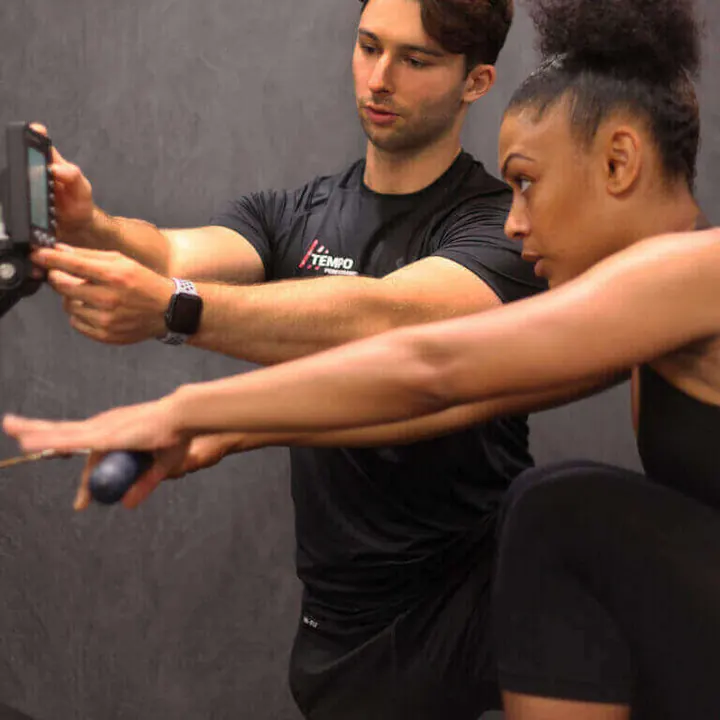
What downhill skiing asks of your body
Turns involve changing forces, repeated lower-body loading and control of the trunk. Muscles may shorten, lengthen under load or hold a position. Eccentric means active lengthening, such as controlling the lowering part of a squat. Isometric means producing force with little movement at the joint.
In 24 fit recreational skiers, a four-hour skiing session reduced measured eccentric hamstring strength and left-leg quadriceps strength; reductions were still present the next day. This supports attention to repeated loading and recovery. It does not prove that a particular gym routine prevents knee injury. Koller et al., 2015.
A 2026 review describes aerobic fitness as supporting capacity in alpine skiing, with a different role from endurance-dominant winter sports. For a holiday skier, that supports including aerobic work alongside strength. It does not justify copying an Olympic athlete's training volume. Sperlich and Holmberg, 2026.
Muscles to train and why
A small on-snow study recorded activity in the thigh, hip, lower leg and trunk, with differences between turn styles. It is older research with only six skiers, so it provides a movement rationale rather than a modern exercise prescription. The training column below is a coaching interpretation. Hintermeister et al., 1997.
| Area | Capacity to prepare | Exercise option |
|---|---|---|
| Quadriceps | Support bent-knee positions; control loading and lowering | Squat, split squat and step-down |
| Hamstrings and gluteus maximus | Hip extension and knee/hip control | Romanian deadlift and leg curl |
| Hip adductors and abductors | Control movement and force between legs | Supported lateral lunge and single-leg work |
| Calf muscles and tibialis anterior | Lower-leg capacity and ankle control within the boot constraints | Calf raise and light shin raise if useful |
| Abdominals, obliques and back muscles | Control the trunk while forces change | Side plank, cable anti-rotation press and row |
| Upper body | General capacity for poles, carrying equipment and getting up | Row and comfortable pushing work |
A 2025 study measured hamstring and quadriceps size and strength in elite skiers. Its athlete profiles are useful context, but they do not establish an ideal strength ratio or screening pass mark for a recreational skier. No universal hamstring-to-quadriceps target is used here. Fitze et al., 2025.
Choose your 2, 3 or 4-day training week
These are total dry-land training days. Strength A/B and conditioning C/D are described below. Extra days first spread the same core work across the week. They do not require more weekly strength sets.
2-day training week
| Plan | Weekly layout | Time and trade-off |
|---|---|---|
| 2 days | Tuesday: A + C. Saturday: B + D | About 75–95 min Tuesday and 70–85 min Saturday. Good when fewer, longer visits are practical; reduce work if quality falls |
3-day training week
| Plan | Weekly layout | Time and trade-off |
|---|---|---|
| 3 days | Monday: A. Wednesday: D + C. Saturday: B | A/B 45–60 min; combined conditioning about 55–60 min. Keeps lifting separate from conditioning |
4-day training week
| Plan | Weekly layout | Time and trade-off |
|---|---|---|
| 4 days | Monday: A. Tuesday: C. Thursday: B. Saturday: D | A/B 45–60 min; C 30–35 min; D 25 min. Shorter visits and more time between training types |
In the first preparation phase, D is easy aerobic work, not intervals. Later, D may become the controlled interval session. For the three-day option, perform D first, then 30–35 minutes of easy C, with the final five minutes very easy. No second warm-up is needed. This keeps approximately the same total conditioning minutes as the other layouts; shorten it if quality falls.
Keep the remaining days free from hard planned training. Comfortable walking is optional. If your work, other sports or travel are demanding, count that when deciding how much you can recover from.
These schedules are practical choices. No comparative trial establishes two, three or four days as the best holiday-ski preparation split. The general principle of fitting strength and endurance together is supported by concurrent-training research, with individual scheduling still required. Schumann et al., 2022.
What goes in each session?
Warm up for 8–10 minutes: easy cycling or walking, comfortable ankle/hip movements and lighter practice sets. RIR means good repetitions left in reserve. Keep about 2–3 RIR, use a controlled range and breathe through the effort. For a new lifter, begin with 1–2 sets per exercise and at least 3 RIR. The full tables are for someone who already tolerates regular training.
Strength A: basic strength and control — 45–60 minutes
| Exercise | Starting work | Rest | Technique focus |
|---|---|---|---|
| Goblet squat or familiar squat | 3 × 6–8 | 2–3 min | Stable feet and comfortable depth; lower over about 2 sec |
| Romanian deadlift | 2 × 6–8 | 2 min | Hinge through hips; keep load close |
| Supported lateral lunge | 2 × 6 per side | 90 sec after both sides | Start shallow; sit towards the moving hip |
| Supported row | 2 × 8–10 | 90 sec | Keep trunk still |
| Side plank | 2 × 20–30 sec per side | 45–60 sec | Keep breathing; stop before position fails |
Strength B: single-leg loading and repeatable positions — 45–60 minutes
| Exercise | Starting work | Rest | Technique focus |
|---|---|---|---|
| Supported split squat | 3 × 6 per leg | 90–120 sec after each leg | Use a comfortable range; start with a 2-sec lowering phase |
| Leg curl | 2 × 8–12 | 90 sec | Control both directions |
| Calf raise | 2 × 10–12 | 90 sec | Smooth movement; no bounce |
| Incline press-up | 2 × 8–10 | 90 sec | Choose a height that leaves 2–3 good reps |
| Wall sit | 2 × 20–30 sec | 60–90 sec | Use a comfortable knee angle; no breath holding or maximal hold |
The wall sit is a small accessory. It does not replace movement through a range, lateral control or skiing practice. The sets, rest and tempo above are coaching proposals based on the demands described earlier. They are not copied from an eccentric-cycling study.
An intervention in 15 junior male alpine skiers tested specialised motor-driven eccentric cycling in place of part of their lifting. Some muscle/jump outcomes improved, but it did not establish this gym menu or a holiday injury-prevention effect. Ordinary exercise-bike pedalling is not the same intervention. Gross et al., 2010.
Conditioning C: steady aerobic work — 30–35 minutes
Start with 5 minutes easy, then 20–25 minutes of steady cycling, brisk incline walking or an elliptical, then 5 minutes easy. Use a pace where you can speak in sentences, about 3–4/10 effort. Begin with less time if your current base is lower. Use a mode that your joints tolerate.
Conditioning D: from easy work to controlled intervals — 25 minutes
In weeks 1–4, keep D easy for 20–25 minutes. From weeks 5–8, if recovery is good, one option is:
- 8 minutes easy preparation.
- 6 × 1 minute at about 7/10 effort, with 1 minute easy between repetitions: five recoveries.
- 6 minutes easy to finish.
Total: 6 hard minutes + 5 recovery minutes + 14 warm-up/cool-down minutes = 25 minutes. Use the bike or elliptical; retain repeatable output and avoid all-out sprints. This is one conditioning session in place of easy D, not an extra day.
For the two-day split, strength comes first and D follows only if you can maintain controlled output. Reduce D or keep it easy if the leg session leaves you fatigued. In the three-day split, D then 30–35 minutes of easy C gives about 55–60 minutes. In the four-day split, Saturday D has Sunday recovery before Monday A. Keep D easy if you do not recover well for the next strength session.
These interval doses are coaching examples. An elite-junior study used a far more concentrated interval block and improved aerobic measures while some jump-power measures fell. That is a reason to consider the trade-off, not a reason to give a holiday skier the same high-volume block. Breil et al., 2010.
Build towards the trip over 8–12 weeks
A 12-week example follows. The phase lengths are a planning choice, not a proven minimum. Use the first weeks to learn how you respond.
| Phase | Main job | What changes |
|---|---|---|
| Weeks 1–4: foundation | Establish technique, regular attendance and easy aerobic work | Start with manageable sets. Keep D easy. Review progress and fatigue in week 4 |
| Weeks 5–8: strength | Build force capacity while retaining aerobic work | Progress one main lift; selected experienced lifters may replace its 6–8 reps with 4–6. D can become intervals. Review/reduce demand in week 8 if needed |
| Weeks 9–11: repeated control | Retain strength and practise controlled repeated effort | Keep two strength exposures; replace selected assistance with the control work below. Progress only one endurance variable |
| Week 12: freshen for travel | Reduce fatigue before the first day on snow | About half the recent work sets, easier conditioning and no new exercises; adjust more if still sore |
For an eight-week window, a possible outline is two foundation weeks, three development weeks, two repeated-control weeks and one easier week. Begin each phase only when tolerated. With only two to four weeks available, focus on consistency and familiar movements; do not compress twelve weeks of loading into a crash programme.
Add eccentric, isometric and lateral work in small amounts
Use one option at a time, as a replacement:
- Controlled lowering: in B, change the split squat from 3 × 6 to 2 × 6 per leg with a three-second lowering phase, using a suitable lighter load. Retain 90–120 seconds after each leg. The lower rep total makes room for the new demand.
- Step-down control: replace A's lateral lunges with 2 × 6 per leg from a low step, lowering for about three seconds and using support. Keep the same rest. Retain lateral practice elsewhere only if it fits the workload.
- Landing and lateral control: for someone already able to land comfortably, replace the lateral-lunge slot with 2 × 4 small side hops per direction, resting 60–90 seconds between sets. Perform them after the warm-up while fresh. Start with step-and-hold practice if jumping is unsuitable; stop when control declines.
- Position endurance: progress B's wall sit from 2 × 20 seconds to 2 × 25, then 2 × 30 seconds at the same angle and rest. Change only one variable. There is no need to chase a maximal hold.
These choices prepare different qualities. No single one recreates a ski turn. Stable ground suits loaded strength work; a balance challenge can be trained separately. A balance exercise's gym score is not a validated pass/fail test for the mountain.
Mobility and stretches for the trip
Before a session, use easy movement plus 6–10 ankle rocks, 6 hip rotations per side and 6 shallow lateral lunges per side. Work within a comfortable range. Follow with practice sets. The numbers are coaching options.
For separate flexibility work, choose two or three areas that feel restricted. Hold a mild stretch for 20–30 seconds, twice per side. Stop if it causes pain, tingling or joint pressure.
| Area | Option | Useful cue |
|---|---|---|
| Calf | Straight- and bent-knee calf stretches | Keep heel down; move gently |
| Hip flexors and quadriceps | Half-kneeling hip stretch or supported standing quad stretch | Avoid arching the lower back |
| Adductors | Supported side lunge or gentle adductor rock-back | Keep the range small and controlled |
| Hip rotation | Supported seated hip rotation | Move at the hip without forcing the knee |
| Upper back | Gentle side-lying trunk rotation | Let the movement stay comfortable |
Use stretching for comfortable range, not as a promise to prevent ACL injury or erase next-day fatigue. Evidence on stretching supports range-of-motion effects; longer static holds immediately before explosive work need care. Behm et al., 2016.
Make progression measurable
Keep a record of load, repetitions, rest, movement range and effort. Also record whether the next session felt normal. For a 3 × 6–8 squat, reach 8/8/8 with about two good reps left across two comparable exposures before considering the smallest load increase. Return towards six reps when you increase weight. This is a practical decision rule.
For conditioning, progress duration, output or recovery density one at a time. Examples: steady work increases from 20 to 25 minutes at the same effort; intervals retain 6 × 1 minute while output rises slightly; or wall-sit duration rises without adding load. A five-minute increase from 20 minutes is 25%, so it may be too large for some people. Smaller steps are valid.
An optional 100/80/60 strength wave
An experienced lifter can replace one main-lift prescription with 5 × 4, then 4 × 4, then 3 × 4 across three weeks. That gives 20, 16 and 12 repetitions: 100%, 80% and 60% of the first week. Allow more time or remove assistance in week one. A fourth week might use 2 × 4 at a lighter load and at least four RIR.
Increase weight only if the previous work was controlled and recovery is good. This is an alternative to simple double progression, not a second programme to add. It also replaces that lift's normal phase prescription. Do not simultaneously intensify intervals, slow lowering and all assistance work. The percentages apply to repetition count, not total ski fitness or total training stress.
This reflects the careful record-keeping and changing rep emphasis associated with Poliquin-style coaching. It is a current coaching interpretation, not a claim about what Charles Poliquin would prescribe today. ACSM's 2026 guidance does not establish complex periodisation as necessary for the average healthy adult. ACSM, 2026.
How to judge whether the plan is working
Start the next block from tolerated work, not an automatic load increase. Compare like-for-like sessions with the preceding block. If the later block becomes harder at the same output, first review recovery and competing demands; repeating or reducing the dose is valid.
At the start and around weeks 4 and 8, compare a familiar squat or split-squat set at the same range and effort. Record wall-sit quality at a fixed angle and duration. On the same bike, compare a familiar steady workload at a similar effort. Improvements help guide the next block; none of these tests certifies injury resistance.
If soreness changes how you use stairs or squat, hold progression and reduce the next lower-body dose. Persistent or worsening pain, swelling or instability needs appropriate assessment. On the holiday, start with manageable runs and take breaks as fatigue builds. Fitness work does not remove the need for lessons and sensible slope choices.
Plan your winter preparation
Bring your travel date, current activity, past skiing experience and any relevant restrictions. Discuss a manageable programme with Julian at Tempo Performance, Fitzrovia. See About Julian and request a consultation.
For supporting reading, see how to combine strength and cardio and mobility training and stretching.
Books and evidence notes
Each scientific claim has a nearby source link. The exact session menus, stretch doses, phase lengths and progression rules are coaching proposals. Direct research on a complete recreational pre-holiday programme is limited; elite-skier findings are not treated as proof for holiday skiers.
- Vladimir Zatsiorsky, William Kraemer and Andrew Fry, Science and Practice of Strength Training, 3rd edition (Human Kinetics). Background reading on strength programming; publisher description and contents consulted, not a full-book review. Publisher listing.
- Tudor Bompa and Carlo Buzzichelli, Periodization of Strength Training for Sports, 4th edition. Planning background; publisher introduction consulted. Publisher introduction.
- Charles Poliquin, Modern Trends in Strength Training, Volume 1, Reps and Sets, third-edition title in the supplied library copy. Selected local pages informed the emphasis on explicit repetitions, rest and records. Historical influence; no claim that it validates this ski plan. Local provenance appears in the editorial source register.
General preparation for recreational downhill skiing, not rehabilitation, ski racing, touring or cross-country skiing.
Continue your preparation
Discuss your goal, current training and available days with Julian at Tempo in Fitzrovia.
Plan your ski preparation