
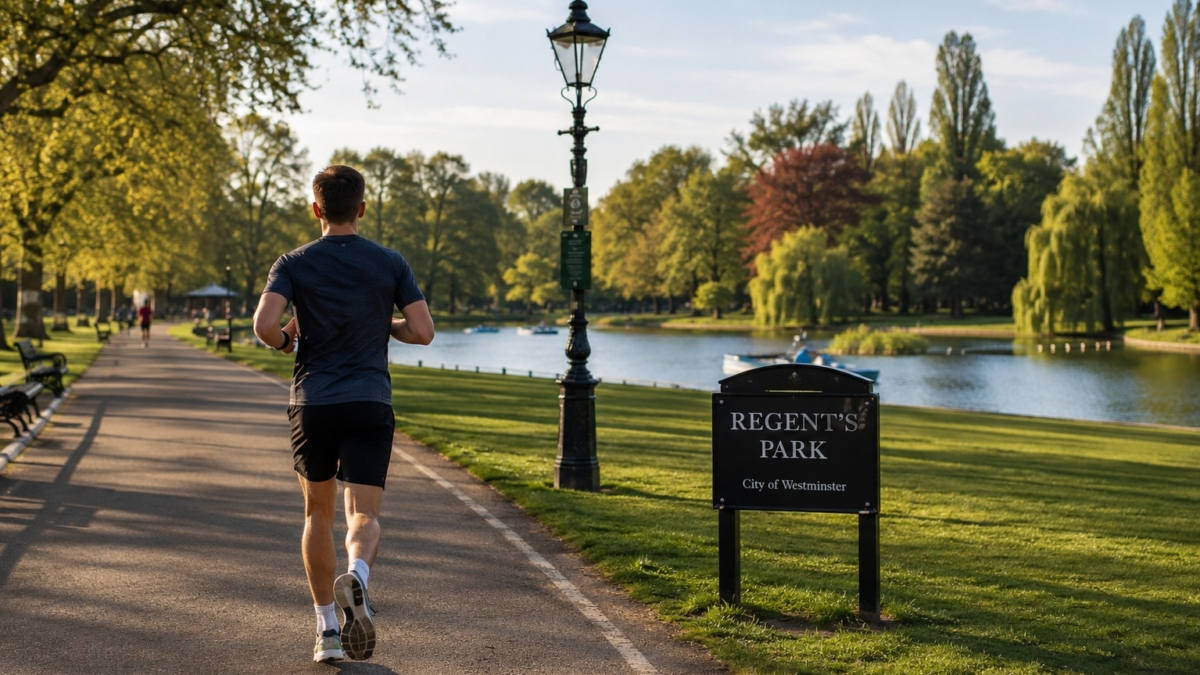
Most people treat running and strength training as separate things. You run on weekends. You lift on weekdays. The two exist in parallel — occasionally getting in each other’s way, never really working together.
That is a missed opportunity.
When running and strength training are programmed together intelligently — each one supports and enhances the other. The strength work makes you a better runner. The running makes your strength training more effective. And the combination produces results that neither approach achieves on its own.
This guide covers exactly how to use weekend runs in Regent’s Park alongside weekday strength training at Tempo Performance PT in Fitzrovia — building a training week where every session contributes to every other session.
New to running? Read our guide first: The Best Park Runs Near Fitzrovia and Marylebone
Why Regent’s Park Is the Perfect Training Ground for Fitzrovia Professionals
Regent’s Park is five minutes from the Tempo Performance PT studio on Hallam Street. For anyone training at the studio during the week, it is the most natural and most accessible weekend running destination in Central London.
The outer circle is 4.3km — just under a 5K — making it a perfect training loop for runners at every level. It is flat enough to run consistently, varied enough to stay interesting, and close enough to the studio to form a natural extension of the weekly training plan.
The Regent’s Park parkrun — every Saturday at 9am — adds a competitive and community element to the weekend run. Free, timed, and open to all abilities — it is one of the most accessible fitness events in London and one of the best motivational tools for anyone building running consistency alongside weekday strength training.
Why Is Regent’s Park Good for Running Training?
Regent’s Park is good for running training for three specific reasons.
First — the surface. The outer circle is tarmac throughout, which means consistent footing regardless of season and weather. You are not navigating mud, uneven ground, or puddles. You run.
Second — the distance. 4.3km is a useful training distance — long enough to be a meaningful aerobic effort at most pace levels, short enough to run twice as a 8.6km weekend long run once fitness builds.
Third — the environment. Running in Regent’s Park on a Saturday morning is genuinely pleasant in a way that running on London pavements is not. The park is quiet before 9am, the air is better, and the absence of traffic lights means you can find and hold a running rhythm properly.
How Weekend Running Builds Weekday Strength
Does Running Help Strength Training?
Yes — and the mechanism is more direct than most people expect.
Cardiovascular conditioning improves training capacity.
A stronger cardiovascular system means you recover faster between sets during a strength training session. You can do more work in the same time. The quality of the strength session improves because you are not gasping for breath between sets of squats.
Running builds leg endurance that complements strength.
The specific leg endurance developed through running — the capacity of the quads, hamstrings, calves, and glutes to sustain repeated contractions over time — complements the maximal strength developed through compound lifting. The two qualities are different and both are useful.
Running keeps body fat low which makes strength gains more visible.
Fat loss is driven by a combination of training volume, nutrition, and consistent calorie deficit over time. Adding two weekend runs to a three-day strength training week meaningfully increases total training volume and calorie expenditure — accelerating fat loss without reducing the strength stimulus from the weekday sessions.
Does Strength Training Make You a Better Runner?
Yes — significantly. And this is the half of the relationship that most recreational runners underestimate.
Stronger legs run more efficiently.
The primary muscles used in running — glutes, quads, hamstrings, and calves — generate the force that propels you forward with every stride. Stronger muscles generate more force per stride, which means either faster pace at the same effort level or the same pace at lower effort. Both are useful.
Strength training reduces running injury risk.
The majority of running injuries are caused by weakness in the muscles surrounding the joints that running loads — knees, hips, and ankles. Stronger quads protect the knee. Stronger glutes protect the hip and lower back. Stronger calves protect the ankle. The clients at Tempo Performance PT in Fitzrovia who combine weekday strength training with weekend running in Regent’s Park consistently experience fewer running-related injuries than those who run without any strength work.
Better posture means better running economy.
Years of desk work create a characteristic posture — rounded shoulders, forward head, shortened hip flexors, weak glutes. This posture is inefficient for running — it increases energy expenditure and loading on vulnerable joints. The strength work at the studio directly addresses these postural issues — which translates into better running form and more efficient movement.
The Weekly Training Structure — Running and Strength Together
Here is the training structure that works best for Fitzrovia and Marylebone professionals who want to combine weekend running in Regent’s Park with weekday strength training at the studio.
How Do You Structure a Week of Running and Strength Training?
Monday — Strength Session at Tempo Performance PT The first strength session of the week. Fresh legs after Sunday rest. Priority movements — squat, hinge, push, pull. The foundation session of the week from which everything else builds.
Tuesday — Easy Run in Regent’s Park (30 minutes) A short, easy-paced run the day after the first strength session. The pace should be genuinely easy — conversational pace, minimal effort. This is not a performance run. It is an active recovery run that keeps the aerobic base ticking over without adding significant training stress to fatigued legs.
Wednesday — Strength Session at Tempo Performance PT The second strength session of the week. Legs have had 48 hours of recovery from Monday. The run on Tuesday was easy enough not to meaningfully compromise strength output. This session can be pushed harder than Tuesday’s run allowed.
Thursday — Rest or Gentle Walk Complete rest or a gentle walk. No training. This is not wasted time — this is when the adaptation from Monday and Wednesday’s strength sessions is happening. Cutting rest short is one of the most common mistakes busy London professionals make with training.
Friday — Strength Session at Tempo Performance PT The third and final strength session of the week. Accessory work and movements that complement the Monday and Wednesday sessions. The legs are fresh enough to train effectively and tired enough that Friday feels like a productive end to the training week.
Saturday — Regent’s Park Parkrun or Longer Run The weekend run. Either the Regent’s Park parkrun at 9am — free, timed, social, and a useful monthly benchmark — or a longer run of 6–10km depending on where you are in your training progression. Saturday morning is the best slot because it happens before the weekend diary fills up.
Sunday — Rest Complete rest. The body needs it. The training week is complete. The adaptation happens during rest — not during training.
How the Regent’s Park Parkrun Fits Into the Training Plan
What Is Parkrun and Is It Worth Doing?
The Regent’s Park parkrun is a free, weekly, timed 5K that takes place every Saturday at 9am. You register once at parkrun.org.uk, bring your barcode, and run. No entry fee, no minimum standard, no pressure.
From a training perspective, parkrun serves two specific functions within the combined running and strength training plan.
Monthly benchmark. Running the Regent’s Park parkrun on the first Saturday of each month and tracking your time gives a consistent, objective measure of running fitness improvement. A parkrun time dropping from 32 minutes to 28 minutes to 25 minutes over a four-month training period is one of the most motivating things you can observe — concrete evidence that the combination of strength training and running is working.
Training stimulus. A timed parkrun is run at a higher effort level than an easy training run. The competitive environment and the official timing produce a faster pace than most people manage in training — which creates a useful higher-intensity stimulus once per month without requiring you to programme specific speed work.
For the other three Saturdays of the month — a longer, easier run of 6–10km around the outer circle of Regent’s Park or the wider Central London park network serves as the weekly long run.
Building From Park Run to Performance — the Progression
The goal of combining weekend Regent’s Park runs with weekday strength training at Tempo Performance PT is not just to finish a parkrun. It is to build a level of physical performance that improves across every measurable marker — running speed, strength, body composition, and day-to-day energy.
Here is how that progression typically looks for clients at the studio.
Weeks 1–4 — Foundation Three strength sessions per week at the studio. One easy run in Regent’s Park at the weekend — 30 to 40 minutes at genuinely easy pace. No parkrun yet — the focus is on establishing the habit and building the aerobic base without adding training stress before the body is ready for it.
Weeks 5–8 — Building Three strength sessions per week. Saturday parkrun or 5K run. One midweek easy run added — Tuesday, 25 to 30 minutes easy. The body is adapting. Strength is improving measurably. Running pace is dropping without conscious effort — the improved cardiovascular conditioning from the running and the improved leg strength from the lifting are working together.
Weeks 9–12 — Performance Three strength sessions per week. Saturday long run — 6 to 8km. One midweek run. Monthly parkrun as benchmark. By this point the combined training produces results that neither approach achieves alone — meaningful fat loss, significant strength improvements, and a running capacity that continues to improve week on week.
What to Eat Around Weekend Runs in Regent’s Park
Nutrition around weekend runs is simpler than most people make it.
Pre-run — Saturday morning before parkrun A small, easily digestible meal 60 to 90 minutes before running. Porridge with protein powder. A banana and a handful of nuts. Two pieces of toast with peanut butter and a boiled egg. Nothing heavy, nothing unfamiliar, nothing that sits uncomfortably in the stomach during a 5K effort.
Post-run — Saturday recovery A proper protein-rich meal within 60 minutes of finishing the run. The combination of the strength training during the week and the Saturday run creates a significant recovery demand — protein is the primary nutritional requirement. Eggs, chicken, Greek yoghurt, or a protein shake alongside carbohydrates to replenish glycogen stores.
Hydration A 5K run at comfortable pace produces minimal dehydration for most people in UK weather conditions. A glass or two of water before the run and consistent hydration through the morning is sufficient. Elaborate hydration strategies are not necessary at the distances covered by Regent’s Park parkrun training.
Why a Personal Trainer Makes the Combined Approach Work
Running in Regent’s Park on Saturdays is straightforward. The parkrun structure, the familiar outer circle route, and the natural weekly habit make it self-sustaining once established.
What is harder to self-programme is the strength training that makes the running better — and the balance between the two that produces results without injury or burnout.
At Tempo Performance PT in Fitzrovia, Julian Ernst programmes the strength training with the weekend running in mind. The leg work on Monday and Wednesday is designed to complement rather than compromise the Saturday run. The recovery structure ensures that Friday’s strength session and Saturday’s run are both productive rather than both compromised by accumulated fatigue.
The result is a training week where every session earns its place — and where the progression from park run to genuine performance happens consistently rather than by accident.
FAQ — Running and Strength Training Together
Q: Can I run and do strength training in the same week?
A: Yes — and the combination produces better results than either approach alone. The key is programming the two intelligently so they complement rather than compromise each other. Three strength sessions and one to two runs per week is the optimal combination for most busy London professionals.
Q: Will running make me lose muscle?
A: At the distances and frequencies described in this guide — no. Muscle loss from running occurs with very high volumes of endurance training combined with insufficient protein intake. Two runs per week alongside three strength sessions and adequate protein produces fat loss and muscle maintenance simultaneously.
Q: What is the best way to combine running and strength training?
A: Strength training on Monday, Wednesday, and Friday. Easy run on Tuesday. Longer run or parkrun on Saturday. Rest on Thursday and Sunday. This structure provides adequate recovery between sessions and keeps the strength and running training from compromising each other.
Q: Is parkrun good for weight loss?
A: Parkrun contributes to a weekly calorie deficit — which supports fat loss. It is most effective as part of a broader training plan that includes strength training. Parkrun alone — without the strength work — produces limited body composition change for most people. Combined with three weekly strength sessions, it accelerates fat loss meaningfully.
Q: How do I get started with combined running and strength training near Fitzrovia?
A: Book a free consultation at Tempo Performance PT on Hallam Street. Julian Ernst builds programmes that integrate weekend running in Regent’s Park with weekday strength training at the studio — balanced, progressive, and designed around your current fitness level and schedule.
Q: Does Tempo Performance PT help with running performance?
A: Yes. Strength training for runners — building the leg strength, core stability, and movement efficiency that makes running faster and more injury-resistant — is a core part of what Julian Ernst does with clients at the Fitzrovia studio.